
AI Didn’t Change Golf Course Visualization, Architects Did


Architectural Vs. Artificial Intelligence in Golf Design
Artificial intelligence (AI) may be the newest tool in architectural visualization today.
But the most important ingredient in AI-generated imagery isn’t the software.
It’s still the architect.
That realization took me back to the first week of college.
One of our earliest assignments in landscape architecture school was simple: sit outside on campus and sketch what you see. I remember sitting there with my sketchbook, feeling completely out of my depth. I had never been a confident sketcher, and my professor was blunt. If you couldn’t learn how to communicate your ideas through drawing, she warned, landscape architecture might not be the right profession for you.
At the time, it felt more discouraging than motivating. Drawing had always been a weakness for me. While other students seemed comfortable sketching perspective views, I struggled to translate what I saw in my head onto paper. For a while I wondered whether that limitation might actually hold me back in the profession.
But architecture — and particularly golf course architecture — has always been about design visualization: communicating ideas for golf courses that don’t yet exist.
Over time, I began discovering different tools that helped bridge that gap.
Design Communication Through Visualization
The first was Photoshop. Not long after graduating, I learned how to create photo montages that blended existing site photography with design ideas. Those early golf course visualizations gave me a way to show clients how proposed changes might look from a real golfer’s perspective.
It was a practical solution that helped me keep moving forward professionally as I continued to improve my drawing.
Eventually, drawing became something I genuinely enjoyed.
A major turning point came when I met Terry Storm, one of the most gifted perspective sketch artists I’ve ever encountered. Terry had produced sketches for several prominent golf course architects over the years, including Ron Fream at Golfplan. When he visited our office, he would sit quietly at a drafting table, transforming our green detail plans into dramatic perspective sketches.
Watching him work was fascinating.
He would study a finished construction drawing — a two-dimensional green detail showing contours, drainage, and bunker edges — and mentally reconstruct how that space would appear in perspective. Within a few hours, he could produce an image that felt alive. The sketches were polished but gritty, expressive but precise. You could feel the architecture in them.
When I told him I wanted to learn to draw like that, his advice was surprisingly simple.
First, you have to be passionate about it.
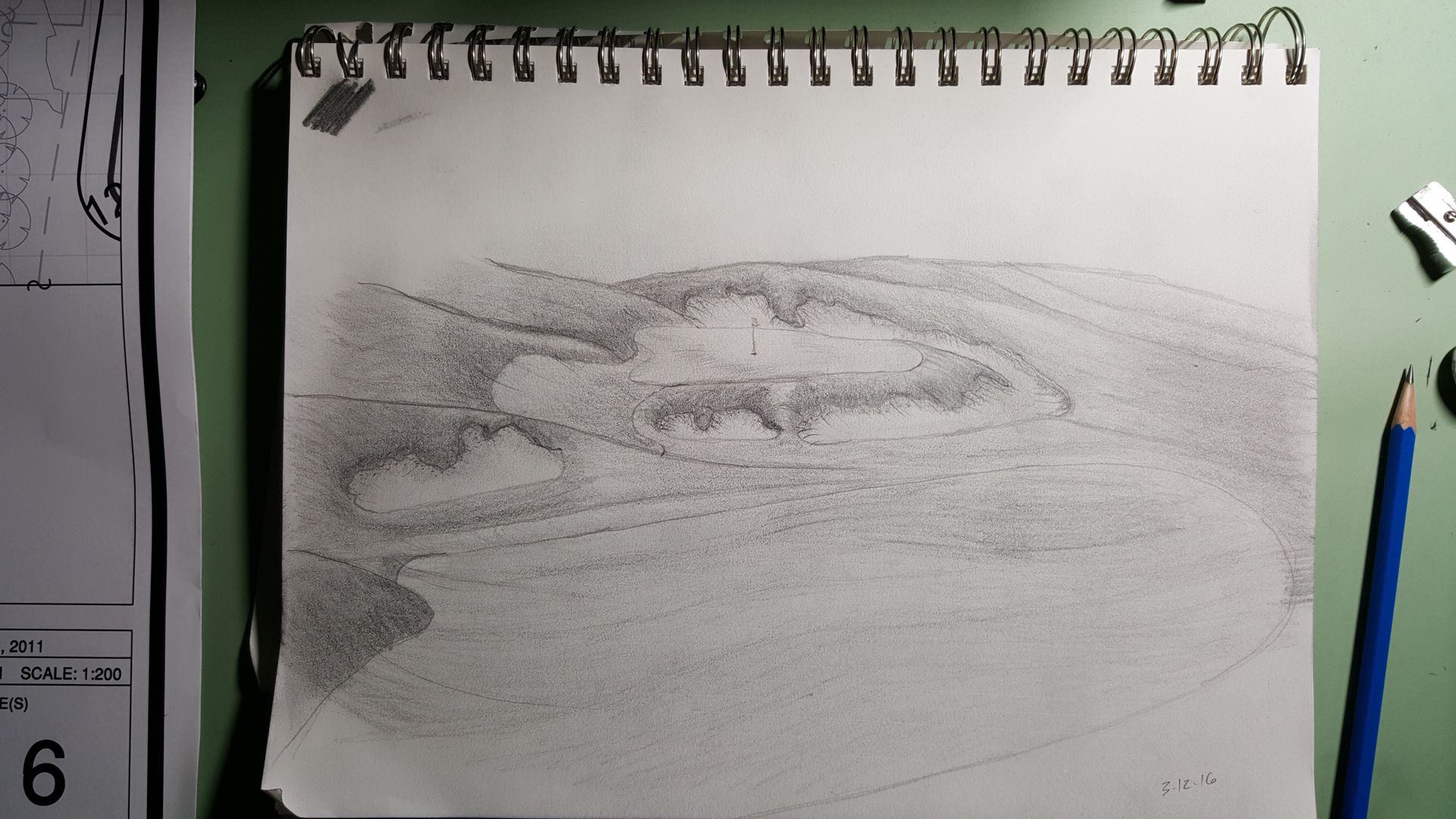
Second, choose the simplest tools possible and master them. Terry often worked with little more than a pencil and a sheet of matte Mylar. The simpler the toolkit, the easier it is to restock, practice, and refine your craft. Your tools become extensions of the hand and mind rather than relying on software to simulate effects.
And finally, repetition. Practice until your hand understands what your mind is trying to communicate.
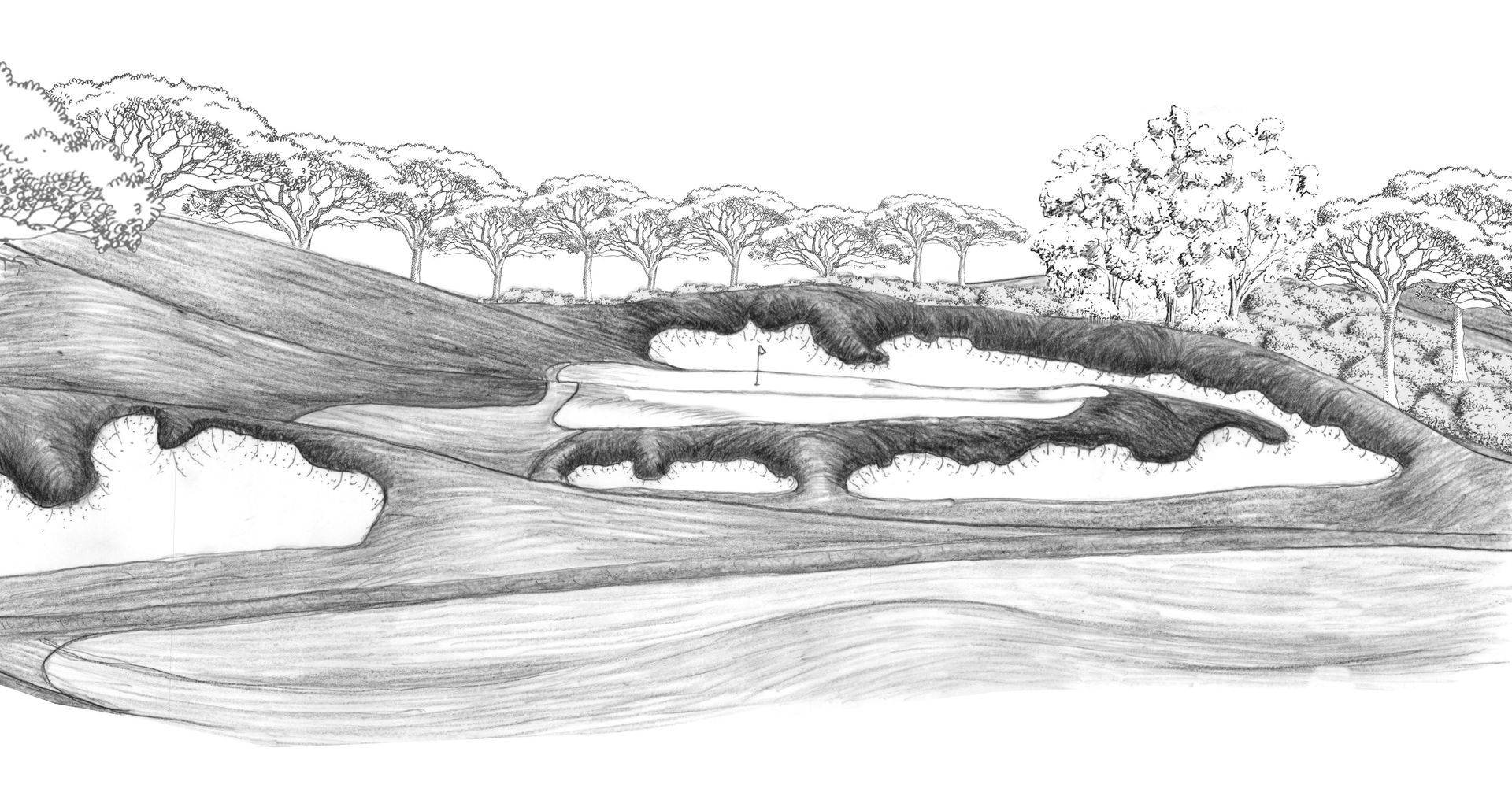
Those lessons stuck with me. Over time I began producing perspective sketches of my own, often pairing them with golf course architecture drawings so clients could understand both the technical design and the experiential view.
Later, I started combining sketches with photography — sketching over drone images or site photos to illustrate changes.
Designing & Communicating Across Distance
During the COVID years, that workflow became invaluable. While working on projects in Vietnam and Japan during my time at Greg Norman Golf Course Design, regular travel wasn’t possible.
Instead, our field teams sent drone footage and site photographs. I would sketch and mark up those images from my desk, sending them back so the shaping crews could understand what we were trying to accomplish on the ground.
Those drawings helped us build golf courses remotely during a global pandemic.
The goal was always the same: help people visualize a future golf course that didn’t yet exist.
When AI Entered the Design Process
Then AI entered the picture.
When image-generation tools first appeared, many architects dismissed them quickly. The results were often cartoonish or architecturally nonsensical. Golf holes would appear with multiple greens, misplaced bunkers, or slopes that made no sense for how the game is played.

I began experimenting with these AI design visualization tools well before they became common in architectural presentations, mostly out of curiosity about whether they could eventually become useful in our design process.
Read more here: Will AI Replace Golf Designers? (2023)
The more I experimented, the more I realized something important.
The problem wasn’t the software.
The missing ingredient was explicit architectural input.
AI tools are remarkably good at interpreting visual information, but they need something meaningful to interpret. When I began feeding the platforms my own perspective sketches — already composed with accurate scale, landforms, and golf strategy — the results improved dramatically.
Instead of asking AI to invent a golf course, I was asking it to interpret an architect’s idea.
That distinction matters.
Why the Architect Still Leads the Process
Today the golf course architecture process at our firm still begins exactly where it always has: with the architect’s hand.
A sketch establishes the composition of the space — the green location, bunker shapes, background landforms, and the perspective from which a golfer will experience the hole.
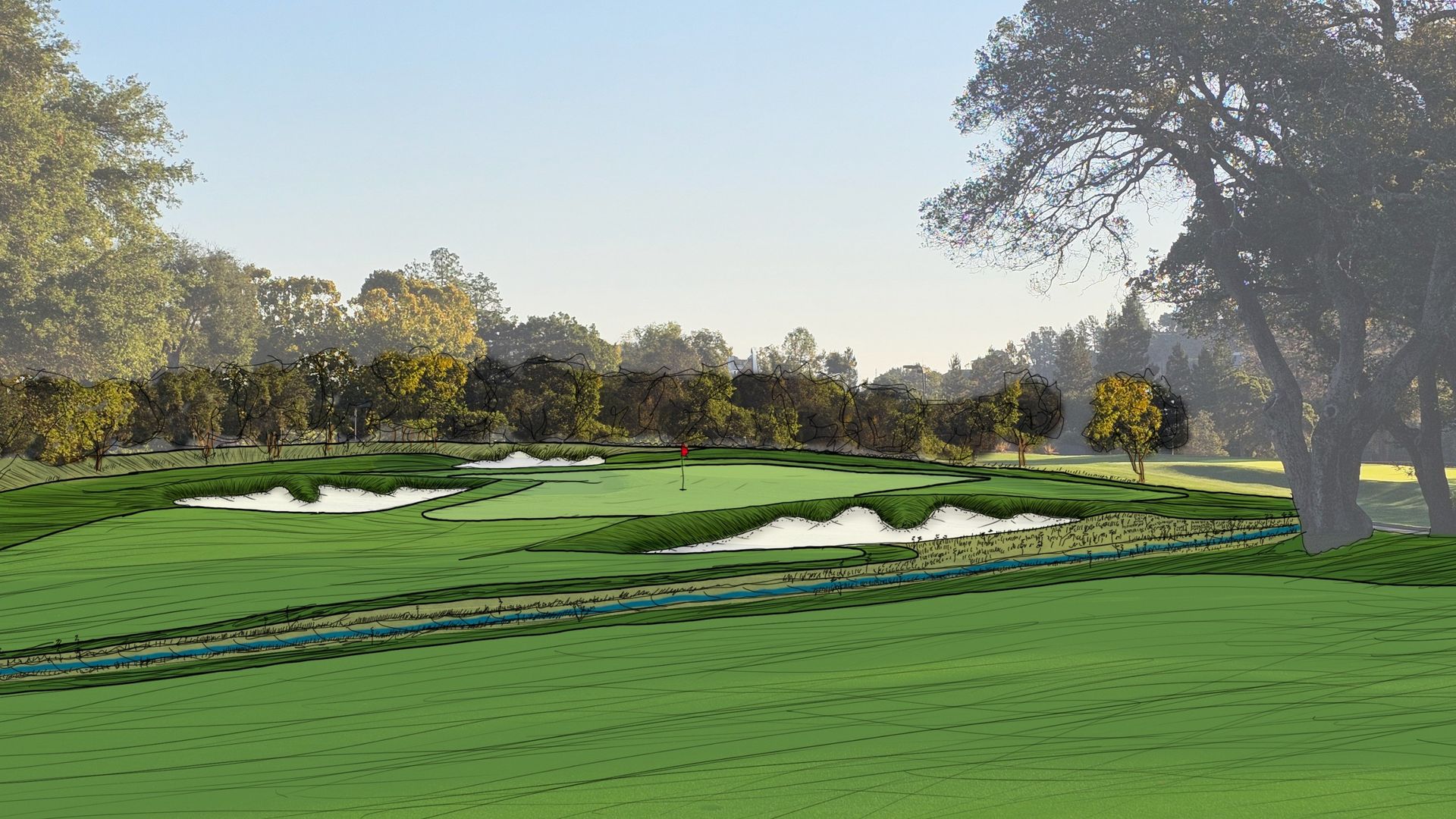
Once that framework exists, AI can enhance it. The technology adds lighting, texture, vegetation, and environmental detail that transform a conceptual sketch into an AI-assisted golf course rendering that appears almost photographic.

In many cases what once required six to eight hours of montage work can now be accomplished in two or three. That efficiency doesn’t replace architectural thinking — it actually creates more room for it, allowing greater focus on intentional design decisions.
Creating Clarity for Golf Course Clients
And the client reaction has been remarkable.
When a group sees a before-and-after golf course renovation visualization that looks convincingly real, the response is often immediate. Instead of trying to imagine what a two-dimensional plan drawing represents, they are suddenly looking at a future version of their golf course that feels tangible.
You can actually hear the moment when the image clicks.
A quiet “ohhh...”
That reaction matters, because most clients — even avid golfers — have no training in construction drawings. Architects spend years learning how a contour on paper translates into landforms and playing strategy in the field. For many people, the connection between plan drawings and real-world experience isn’t intuitive.
Visualization bridges that gap.
When people can see a proposed change through the same perspective they experience the course, something important happens. The idea stops feeling abstract. It becomes believable.
Confidence grows.
And when enough people share that confidence, alignment follows.
Read more here: If You Have to "Sell" The Master Plan, It's The Wrong Plan
That’s why visualization has always been such a powerful tool in golf course architecture planning.
It’s not about making something look impressive. It’s about helping people clearly understand what the future of their course could be.
Architectural Intelligence (AI)
Technology has changed the tools we use to do that. But the underlying responsibility hasn’t changed.
Golf course architecture still requires understanding land, strategy, and how people experience space.
It requires judgment about scale, contour, and composition — and the ability to imagine a place long before construction begins.
Like every visualization tool before it, AI is most powerful in the hands of someone who already understands how a space should feel before the dirt moves.
AI can amplify that thinking. It can accelerate the process and add remarkable realism to architectural concepts.
But the ideas still originate in the architect’s mind.
The framework is still crafted by hand.
The technology simply helps translate those ideas into images others can understand more clearly.
Crafted by hand. Enhanced by technology.
And when a visualization finally captures the idea clearly enough that people can see the future of their golf course in front of them, something powerful happens.
Uncertainty fades.
Confidence grows.
And the path forward begins to feel inevitable.
Author’s Note
Jeffrey Danner currently leads a task force within the European Institute for Golf Course Architects (EIGCA) studying the implications of artificial intelligence for golf course architecture, including questions related to professional ethics, design authorship, and best practices for the use of AI in golf course architecture.